
Click on the questions below to see their corresponding answers.
Air Travel
01. May a traveler use companion coupons in conjunction with State travel?
Yes, the traveler is required to book and pay for the entire cost upfront using a personal versus State form of payment, and the State will reimburse the employee for the full cost of the business travel when the travel authorization is finalized. The employee remains responsible for the costs associated with utilizing the coupon including the related fees and taxes. E-Travel must be used to determine the State portion of the trip prior to travel. AAM 60.080
02. An employee or non-employee traveling on official State business acquired an airline ticket by cashing in an airline mileage coupon and used the ticket for State business travel. May the State pay this individual the amount a similar ticket would have cost had it been purchased?
No, the employee or non-employee traveling on official State business is not entitled to any payment except to be "reimbursed" for actual and necessary expenses incurred. AAM 60.010
03. Can a traveler be required to fly a particular airline?
The State can require an employee to fly a particular airline. The State in making a decision about which airline to fly is to have considered cost, contracts and convenience of the schedule, etc.
The ultimate decision rests on what is in the best interests of the State. (Source: AAM 60.050)
04. How is accumulated mileage tracked and spent?
All mileage is earned in a single EasyBiz account that is tracked by the travel management contractor for each department. Departments identify who on their staff is authorized to "spend" miles. The travel management contractor purchases travel with mileage when directed to do so by authorized department personnel.
05. Does E-Travel affect a traveler's ability to accumulate miles?
No, travelers will still receive "seat miles" unless flying on a ticket purchased with EasyBiz miles.
06. Why does all of the Alaska Airlines mileage accrual go to a statewide pool and not to the department?
The Alaska Airlines contract provides the state a discount on all published fares, except web specials, in place of mileage accrual. There will still be some accrual, but it is estimated that the state may only accrue enough miles for one or two tickets per year. Having a statewide pool allows the opportunity to aggregate miles earned to redeem for a ticket instead of having a small amount of miles spread between the departments, which individually would not provide a redemption opportunity.
The state can accrue miles by "purchasing" tickets through USTravel for the following:
- E-Certificates
- Group Discount Codes
- Constituent Fares
07. What are the guidelines to use mileage from the statewide pool?
Beginning July 1, 2011 all mileage accrual is being deposited into the statewide pool. Mileage redemption is available on an as-needed basis with the following recommended guidelines:
- Ticket is for out of state travel
- The ticket value is $800 or more
- Ticket is for a non-profiled traveler
- No travel deviation is permitted
Requests to use mileage from the statewide pool should be sent to the ETMT.
Return to list of FAQ Topics
E-Travel
01. What is E-Travel?
E-Travel is the managed travel program within the Executive Branch of the State of Alaska. It is comprised of:
- Travel policies contained in AAM 60
- E-Travel Online, which is the online tool used for approving, purchasing, and reimbursing travel provided by the contracted travel agency
- Travel management contractor, which is currently USTravel
- Other contracts with vendors in the travel industry including airlines, hotels, and rental car agencies
- E-Travel Management Team (ETMT), which includes the State Travel Manager, as well as others from the Division of Finance that support this program
- Travel coordinators, travel administrators, and travel planners within each department
- Employees and others traveling on official State business
02. What is the role of travel coordinators, travel administrators, and travel planners?
Travel coordinators are the lead within each department for travel policy interpretation and enforcement. They act as liaisons with the E-Travel Management Team (ETMT) for departmental issues with E-Travel and provide input into policy development. Travel coordinators analyze travel data for their department for policy compliance and identify the need for traveler or travel planner education. Generally each department has one travel coordinator and a backup.
Travel administrators are department personnel responsible for maintaining the travel profiles for their department. They may or may not also be the department's travel coordinator.
Travel planners are individuals within each department that support travelers by making travel arrangements, explaining policies, ensuring travel is approved prior to purchase, and ensuring reimbursement occurs timely after travel is complete. Departments designate a sufficient number of travel planners to meet their business requirements.
03. What is required for travel approvals?
Approvals require:
- the name of the travel arranger, and
- the name of the approving official.
Departments document their internal approval processes (who can approve in what circumstances) on a per trip basis by entering the information when purchasing in E-Travel Online or by giving the information to the travel management contractor agent when purchasing by phone.
04. Can travelers be set up to select their own arrangements?
Yes. All employees with travel profiles can use E-Travel Online to choose air, car, and hotel options, and to save the research for their travel planner. Research can be emailed to the traveler's supervisor and/or travel planner for approval and purchase.
In addition, departments are encouraged to allow travelers to hold or purchase their own reservations using E-Travel Online. Travel planners can monitor their travelers' purchases in the tool.
05. Can I still call the travel management contractor for travel arrangements?
Yes. The travel management contractor can be reached at 907-500-4292 or 866-762-8728 for travel agent assistance with itineraries.
06. When should travelers contact the travel management contractor directly?
All travelers can contact the travel management contractor for assistance as necessary during travel. The after hours emergency number is 888-423-2434. For after hours booking refer to your department's travel policies to determine the rules for booking emergency travel. In addition, any travelers or travel planners using E-Travel Online may call 907-500-4290 for assistance with the tool or send an email using the Contact USTravel Agent link located in the Help menu within the E-Travel Online tool.
07. Should the travel management contractor be used for arranging travel for non-employees?
Yes. E-Travel serves the entire Executive Branch including boards, commissions, witnesses, inmates, and others in State care. E-Travel should not be used for contractors or trainers whose travel should be included in their contract for services.
08. What are the fees associated with E-Travel?
The fee is charged for a trip (any combination of air, ferry, rental car, and hotel) and consists of two components:
- The contractor's portion was established by competitive bid (currently $6.50 for unassisted and $15.50 for travel agent assisted itineraries), but the contract allows amendments based on CPI and up or down 20% based on performance. Changes to itineraries are $7.75 for the contractor's portion.
- Department of Administration's recovery of E-Travel Management Team (ETMT) costs, which are subject to OMB approval (current fees can be found on the E-Travel Fees page).
09. How are traveler profiles updated?
Travelers may add personal information such as mileage plan numbers, seating preferences, personal phone numbers, secure flight and emergency contact information to their profile in E-Travel Online.
Charge card information will update automatically within two days once the cardholder activates their card.
Traveler name changes are updated by ETMT.
Return to list of FAQ Topics
Per Diems
01. Must departments rigidly adhere to the
travel timeframes in AAM 60.040?
Individuals approving travel may use judgment in determining what
departure times best serve the State. For example, for travel
crossing several time zones, it may be beneficial to begin the
travel the previous day so travelers are rested for the purpose of
the trip. AAM 60.040
02. Is the rental of a travel trailer
considered commercial lodging, or noncommercial lodging?
The rental of a travel trailer would be considered commercial
lodging under AAM 60.020 as long as the trailer is rented from a vendor in the business of
renting travel trailers.
03. What is the appropriate per diem to pay
a GGU or SU employee who is staying in their motor home while on
long-term travel status within Alaska?
This depends on where the motor home is located:
- If at a commercial campground, traveler receives actual
receipted lodging cost for first 30 days, then $45 per day long
term-lodging allowance.
- If not at commercial facility, traveler receives $30 per day
noncommercial lodging allowance for first 30 days. After the 30th
day, traveler continues to receive $30 a day if in location where
no commercial facilities are available. If commercial facilities
are available but not used, no lodging allowance after the 30th
day.
- In either situation, the employee also receives $33 a day
M&IE allowance.
04. If an employee is traveling to a village
where there are no commercial lodging facilities, what per diem
are they allowed?
The purpose of the travel policies, per AAM 60.010,
is to provide reimbursement of actual and necessary expenses
incurred by employees because of travel on State business. If an
employee travels to a location where it is known they will not
incur lodging expenses consistent with the rate at which per diem
was established, they are only allowed a per diem or reimbursement
commensurate with the expenses they are likely to incur. Lodging
per diem for noncommercial is $30 a day or receipted costs,
whichever is higher. AAM 60.240
05. If an employee is temporarily assigned
for a few months to a duty station away from the normal duty
station and residence, and returns to the residence in the
interim, should the State pay long-term lodging allowance while at
the residence?
If the employee is incurring expenses to pay for lodging at the
temporary duty station and it is necessary to do so to retain the
lodging for the duration of the assignment, the State pays the
long-term lodging allowance even when the employee is at the
residence. AAM 60.240
06. Does an employee who works in Anchorage
and is assigned to Juneau during the Legislative session receive
the long-term per diem rate for the entire time they are in
Juneau, or do they receive the short-term per diem rate for the
first 30 days and then receive the long-term per diem rate for all
days after that?
If it is known from the outset of the trip that the employee will
be in long-term travel status (more than 30 consecutive days in a
location with commercial facilities for long-term visitors), then
the entire trip shall be at the long-term per diem rate.
Short-term per diem would be used in circumstances where an
employee travels to a location, begins the project, and then is
required to stay longer than anticipated. Even in this example, at
the point it is known the employee will be there long enough to
incur expenses comparable to those arising from the use of
establishments catering to the long-term visitor; the long-term
per diem rate should be used. However, this interpretation applies
only to employees subject to the administrative manual provisions,
as some of the bargaining agreements have different rules
regarding long-term per diem. AAM 60.240
07. A noncommercial lodging allowance is
paid when travelers elect to stay in noncommercial lodging for
short-term travel within Alaska. Does this mean the traveler is to
receive this allowance whether they ask for it or not, and even if
they specifically state they do not want it?
Yes, for member of bargaining units. They must be paid the
noncommercial lodging allowance unless a Letter of Agreement to
the contrary is signed between the union and the Division of
Personnel and Labor Relations.
Noncovered employees who wish to decline the noncommercial lodging
option may do so. This choice should be documented as part of the
final travel reimbursement.
08. For travel outside the State of Alaska,
how is the incidentals portion of the M&IE amount handled?
Travelers are entitled to the full incidental portion of the M&IE $5 for short term, and $3 for long term) for each day or portion of a day they are in travel status outside Alaska and M&IE is provided for one or more meals for that day. For full days, the total CONUS amount for the location is used. For partial days, or days in which a meal is
provided, the traveler is entitled to sum of the remaining meal amounts and full incidentals portion of the M&IE.
09. If an employee (PSEA bargaining unit)
leaves their duty station on a trip, but is not required to obtain
overnight lodging that first night because they are traveling
overnight by plane, are they entitled to the lodging portion of
the per diem for that first day?
This was discussed with Labor Relations. The PSEA language is
intending to reimburse costs for lodging. Therefore, if the
employee incurs costs for lodging for that first day, they would
be entitled to per diem for lodging. However, if no overnight
lodging is required then they are only entitled to the applicable
meal allowance.
10. Is an employee entitled to receive per
diem upon arrival at the new duty station (under the moving
section policies in the Administrative Manual) plus per diem while
in business travel status during this same time period?
If it is reasonable to presume the employee is incurring expenses
for lodging at their duty station related to the move to the new
duty station in addition to expenses while in travel status, the
employee would be entitled to the appropriate lodging and M&IE
allowance while in travel status, plus the lodging portion of the
per diem (which is related to the move) at the duty station. For
example, the employee's spouse remains at the duty station
location looking for housing while the employee is traveling on
State business. AAM 60.240
11. An LTC employee is sent to a location
for several days to perform inspections of a vendor's
facilities. The vendor provides the employee with lodging and
meals. Is the employee entitled to a per diem for lodging and
meals?
The LTC contract, section 15.02, allows an LTC employee to receive
a per diem for lodging if quarters are not furnished. Since
quarters were furnished, the employee is not entitled to the
lodging portion of the per diem. Section 15.03 allows an LTC
employee to receive an M&IE allowance any time they are more
than 50 miles away from their duty station in accordance with
section 60.250 of the Alaska Administrative Manual. AAM 60.250
states, "When a traveler is provided a meal in these or similar
circumstances (meals provided by vendor), the traveler is not
eligible for the related M&IE allowance unless sufficient
justification is provided by the traveler and approved to obtain
the M&IE allowance." The M&IE payments in this situation
are treated as taxable compensation.
12. A GGU employee is sent to a location on
long-term travel. The employee is staying in a commercial facility
(hotel) for a week until their long-term lodging facility is
available. What is the appropriate M&IE at this location?
The reason for long-term M&IE is to reimburse an employee for
M&IE associated with staying in a facility which is catering
to the long-term visitor. If the employee is staying in an
apartment or other long-term stay facility, the employee would be
entitled to the long-term M&IE. However, if the employee is
staying in a hotel, it is usually expected that they will be
eating their meals at a commercial facility and they would be
entitled to the short-term M&IE. Therefore, in this instance,
the employee is entitled to the short-term M&IE for the first
week while staying in the hotel, and then the long-term after
that. AAM 60.250
13. A witness is entitled to the same per
diem for lodging and meals as allowed State employees. When a
witness must bring their dependent children with them, what is the
appropriate M&IE rate?
Although this is not specifically addressed in section AAM 60.250,
if it is necessary for a witness to bring their dependent children
with them, reimbursement should be at the rate allowed for
dependents during a move, which is $25 per day.
14. What is the appropriate M&IE for the
first 30 days of travel when a GGU employee is traveling in
long-term travel status where they are provided with lodging by
the State and only need to be paid an M&IE?
The GGU contract provides for an M&IE allowance in accordance
with Administrative Manual section AAM 60.250.
In this instance, we have knowledge the employee is in long-term
travel status at the beginning of the travel. Therefore the
appropriate M&IE allowance is the long-term rate.
15. Is a traveler entitled to a meal
allowance if they awaited an outbound flight at the local airport
on a day flights were delayed due to weather or mechanical
problems?
If it were reasonable and necessary for the employee to sit at the
airport, the employee would be entitled to the appropriate meal
allowance even though they may be at their duty station. AAM 60.250
16. What is the appropriate M&IE
allowance to use on the day an employee returns to their duty
station?
The M&IE allowance is the rate for the location from which the
employee is departing. AAM 60.250
17. Should a traveler's meal allowance
be reduced when meals are provided as part of travel costs the
State is paying, such as at a conference or as part of lodging?
Yes, if a meal was provided as part of the fee for a conference or
is part of a lodging package, such as staying in a bed and
breakfast, the employee would not be eligible for that meal
allowance. If an employee does not choose to partake in a meal
provided to them, they must provide written justification and
obtain approval by the department to obtain the meal allowance. If
a cold complimentary continental breakfast such as toast and
pastries is served at a hotel and is not consumed by the traveler,
then no deduction for the meal allowance should be made.
Department travel desks should ensure that travelers understand
this and reflect it on the travel authorization or expense report. AAM 60.250
18. If the State has contracted with a
facility to provide meals for their travelers while on State
business, can they still collect the meal per diem?
No, in this particular case, the State has a contract with the
vendor to provide meals for the travelers. This situation would
fall under AAM 60.260,
contracting for subsistence, and the issue of whether the meal was
consumed would not be a factor.
19. If an employee is on official travel
status (outside their duty station boundary), but that status is
less than twelve hours, are they eligible to receive any allowance
for meals?
No, this would be considered a "day trip" and no
allowance for meals would be provided, except for LTC employee in
travel status at least ten hours. AAM 60.250
20. Since the travel status definition only
refers to the duty station, does this preclude travelers from
receiving per diem when they depart from their residences on State
business?
Travel status eligibility is determined based upon the duty
station location and the destination of the approved trip. When an
employee is driving to a destination and departing outside normal
work hours, the trip begins when the employee leaves the
employee's residence. When the employee is flying, the flight
departure time plus the two-hour required check-in time is used as
the basis for when the trip begins.
21. If an employee is in travel status, yet
staying at the employee's own residence at the travel
destination, is the employee eligible to receive per diem for
lodging and/or meals?
A traveler staying at the traveler's residence in a travel
destination is entitled to receive a meal allowance for normal
workdays. No allowance would be paid for lodging and no meal
allowance would be paid for regular days off.
22. Can travel status start earlier than two
hours before scheduled departure if the traveler must drive more
than 50 miles to the airport?
Travel status is based on duty station, not residence. If
substantial driving is required from the duty station to the
airport, then the drive time may be added to the two hours in
advance of scheduled departure time that is generally allowed.
However if the traveler lives farther from the airport than the
duty station, travel status is limited to the two hours in advance
of scheduled departure. Mileage reimbursement is allowable for all
travelers for the distance actually traveled to and from the
airport.
23. Can an employee with an Anchorage duty
station receive per diem for an overnight stay in Palmer or
Girdwood?
Generally not as both of these locations are within the 50-mile
radius used by the State of Alaska to define travel status.
However, AAM 60.010 allows commissioners to approve policy exceptions for personnel
within their departments based on documented circumstances or
unique business requirements. Commissioners may make such
exceptions to put employees in travel status for a business reason
such as meeting or networking activities scheduled in the evening,
or to avoid hazardous winter driving conditions. Exceptions of
this nature must be in writing and include the justification. When
exceptions are approved, the employee is in travel status and is
entitled to lodging and an M&IE allowance. However, they would be considered taxable to the employee as they are not outside of their duty station boundary.
Return to list of FAQ Topics
Personal Travel
01. What is a personal travel deviation?
When a traveler stays longer at the State-authorized destination
for personal reasons, it is a deviation with an extended stay.
When a traveler goes to a different destination outside of the
State-authorized destination, it is considered a personal
deviation with a routing change. AAM 60.080
02. Do I have to use USTravel or E-Travel Online
to book travel that includes personal travel?
It depends. Employees traveling on State business that are
authorized to include a personal deviation are not able to book
travel through USTravel or E-Travel Online if a personal form of
payment is necessary for any portion of the trip or when the
routing is different than the State authorized routing.
Personal travel that includes an extended stay must use E-Travel
when the department has approved the use of a State form of
payment for the entire trip. AAM 60.080
#2
03. If my trip includes personal travel with a
routing change how do I book my airfare?
The airfare must be booked and purchased by the traveler on their
own time outside of E-Travel Online using a personal form of
payment (not the State One Card). A State-authorized fare quote
must be obtained when the travel is approved for a price
comparison to determine traveler reimbursement. Once travel is
completed the traveler must present a copy of the ticket receipt
or itinerary showing payment and the State-authorized fare quote
to obtain reimbursement. AAM 60.080
#2 & #3
04. What are my options if the personal travel is
an extended stay at some point in the State-authorized routing?
If the personal deviation is an extended stay at some point in
State-authorized routing, departments may opt to pay for the
combined trip (State-authorized portion including the personal
extension) if the additional cost of the personal portion can be
recovered from the traveler's reimbursement after travel is
complete. A State-authorized fare quote must be obtained as a
basis for determining the reimbursement amount.
If the department cannot or chooses not to collect the additional
cost of the personal travel from reimbursement, the traveler will
have to book the trip outside of E-Travel using a personal form of
payment, and after obtaining a State-authorized fare quote for
determining the reimbursement amount. Once travel is completed,
the traveler must present a copy of the ticket receipt or
itinerary showing payment and the State-authorized fare quote to
obtain reimbursement. AAM 60.080
#2 & #3
05. What is a State-authorized fare quote and how
do I get one?
A State-authorized fare quote is a quote that determines the cost
of a State-authorized business trip without any personal travel.
The fare quote may be obtained and saved in E-Travel Online with
the research option, or by calling USTravel at 866-762-8728 or
500-4292 (in Juneau). This fare quote will be sent back to the
department and used to determine the amount of money reimbursed to
the traveler once the travel has been completed. The
State-authorized fare quote must be obtained prior to the purchase
of the ticket for equivalent price comparison. AAM 60.080
#3
06. What are the fees associated with a
State-authorized fare quote?
There is no fee for using the research option in E-Travel Online
to save or print out a State-authorized fare quote. If the
traveler or travel planner calls USTravel for a fare quote when
the travel is approved, the agent assistance fee will be charged
to the State form of payment. If no State-authorized fare quote
was obtained prior to travel, the travel planner will obtain a
fare quote for the lowest fare for the State routing as part of
completing the travel authorization, and the fee will be charged
to the traveler. AAM 60.080
#3
07. How much of the airfare cost will the State
reimburse the traveler?
The State will reimburse the lesser amount of either the actual
ticket cost or State-authorized fare quote after travel is
complete. If cases where no fare quote was obtained prior to
travel, the travel planner will call the contracted travel agency
for a quote for the cheapest fare currently available for the
State routing, and the State will pay the lesser of the actual
ticket cost or the new quote, regardless of whether it was
available previously. AAM 60.080
#3
08. What if the State-authorized fare quote
increases between the time it is submitted for approval and the
time it is approved?
Approvers should strive to take action quickly on requests to
avoid increases of this nature. In cases of delayed approval, a
new State-authorized fare quote may be obtained upon approval to
provide the comparison fare for calculating the amount to be
reimbursed the traveler.
09. How much will the State reimburse the
traveler for travel with deviation for personal convenience?
Per diem, travel allowances, and reimbursements are calculated for
the minimum itinerary that is required to conduct state business
without regard for the actual itinerary that includes the
deviation for personal convenience.
Example: Employee is scheduled for a conference in Florida
(Tuesday-Thursday); the employee is staying over in Florida until
Sunday and then flying to Seattle, where they spend two nights
before returning home to Juneau on the following Wednesday. Direct
route would fly from Juneau to Florida Monday, return Friday
because there are no flights leaving Florida for Seattle after
5:00pm when conference ends on Thursday.
Direct Route Per Diem and Hotel
- Per Diem - Florida per diem - Monday through Friday - $56 per day
and Friday is a full travel day for a total of $280.
- Hotel - Four nights at $150 per night. The State will pay the cost of four nights (Monday through Thursday) at the hotel for a total
of $600.
Deviation Per Diem and Hotel - Without regard to
actual in and out of travel status, the State would reimburse the
direct route per diem and hotel.
- Per Diem - total of $280.
- Hotel - total of $600.
10. Can a traveler elect to stay over the
weekend, collecting per diem and hotel if the total cost of the
trip is less than returning on Friday?
Generally not. AS 39.20.140(d) authorizes travel only the least number of days necessary to
transact State business, so cost comparisons of this nature are
irrelevant.
11. Can a traveler elect to stay over the
weekend, or use leave in conjunction with State travel?
Yes, with prior approval. Deviations for traveler convenience are
allowable when approved by the applicable department in advance of
the travel. Several conditions apply to personal time in
conjunction with State travel:
- any additional cost for routing is borne by the traveler;
- State airfares cannot be used for personal travel routing and
can only be used for deviations with extended stay when the
department opts to pay for the combined airfare, AAM 60.080 #2;
- State rental cars must be returned, AAM 60.080#4;
- lodging for the personal portion is subject to all taxes and
must be paid by the employee, AAM 60.065; and
- State per diem and reimbursements are allowed for the minimum
itinerary that is required to conduct State business without
regard for the actual itinerary that includes the deviation for
personal convenience. AAM 60.080
#1
- Taxi or shuttle service to the airport during deviation travel
is reimbursable if it normally would be considered as part of the
minimum business itinerary.
12. An employee on State travel status concluded
State business on Friday, but rather than return on Friday
evening's flight, stayed on personal business for the weekend
and was scheduled to return on Sunday. The Sunday flight was not
able to return because of weather, and the employee incurred
additional expenses for lodging and meals. May the State reimburse
the employee for those expenses?
No. The employee is not entitled to reimbursement for these
additional expenses. Any additional time or expense resulting from
a deviation for employee convenience is the responsibility of the
employee. AAM 60.080
13. A traveler must be at work in Dallas on
Monday at 3:00pm. The minimum itinerary to conduct State business
would fly to Seattle on Sunday evening, and into Dallas on Monday
morning. The traveler chooses to go to Seattle on the previous
Friday evening and stay with family for the weekend, flying to
Dallas on Monday morning. Is the traveler entitled to the value of
a hotel room?
No, because the traveler stayed with family. Lodging is limited to
a reimbursement of actual costs required for the minimum State
business itinerary. If the traveler incurred lodging expenses in
Seattle anytime between Friday and Sunday, the State would
reimburse the cost of one night lodging at a moderately priced
hotel as required by the minimum State business itinerary.
The traveler is entitled to M&IE beginning on Sunday afternoon
two hours before the scheduled departure of the last flight to
Seattle.
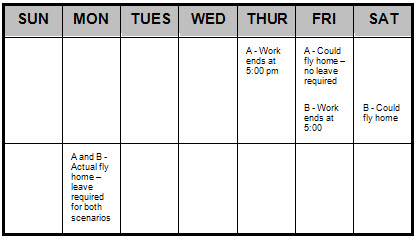
14. A traveler is on duty through Thursday at
5:00pm in New York. Instead of flying home on Friday (minimum
business itinerary), pre-trip the traveler requests and is
authorized for a personal deviation to stay the weekend, and fly
home on Monday. Is leave required for traveling during a work day
as a result of this personal deviation? What if work ended at
5:00pm on Friday, and the traveler could have flown home on
Saturday. Is leave required to fly home on Monday?
Yes, leave is required because in both scenarios it requires
traveling outside the minimum business itinerary. It is irrelevant
whether the minimum business itinerary would require flying on a
work day or weekend. However leave is not required for Friday,
when the first minimum business itinerary would have required
travel.
Overtime-eligible employees are paid for required travel for the
minimum business itinerary regardless of whether it occurs on
Friday or Saturday. They would be paid for "travel as time
worked" for the hours of travel within the minimum business
itinerary without regard for the Monday flight times. Payroll
costs cannot be increased by personal travel deviations.
The time worked calculations are not part of travel processing.
Supervisors are responsible for ensuring subordinate staff work or
turn in leave slips appropriately regardless of travel status. AAM 60.080
#5
Example:
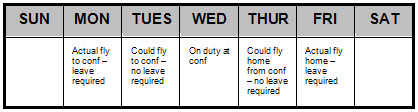
15. A traveler must attend a conference in San
Francisco on Wednesday, and the minimum business itinerary
requires travel on Tuesday and Thursday. Pre-trip, the traveler
requests and is authorized for a personal deviation to fly on
Monday and Friday, in order to spend extra time enjoying San
Francisco. When is leave required?
Leave is required for Monday and Friday, as the minimum business
itinerary requires travel on Tuesday and Thursday. The traveler
would be in work pay status for the same period they would be
eligible for travel reimbursements - two nights hotel stay and
M&IE Tuesday through Thursday.
Example:
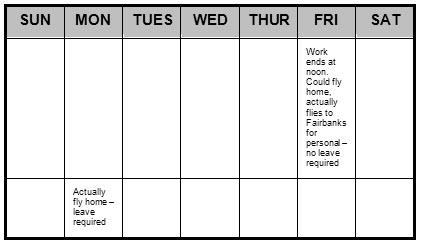
16. A traveler is working in Anchorage until
Friday noon. Instead of returning home to Juneau Friday afternoon
(minimum business itinerary), pre-trip the traveler requests and
is authorized for a personal deviation to travel to Fairbanks for
the weekend and return to work in Juneau on Monday afternoon. When
is leave required?
Leave is required for the time related to flying home on Monday.
Leave is not required for Friday afternoon, as the minimum
business itinerary required flying home during that period.
Example:
17. Is business travel combined with a pre-trip
authorized personal deviation covered by the workers'
compensation?
"An identifiable deviation from a business trip for personal
reasons takes the employee out of the course of employment until
the employee returns to the route of the business trip, unless the
deviation is so small as to be disregarded as insubstantial."
...
- Arthur Larson & Lex K. Larson, Larson's Workers'
Compensation Law § 17, at 17-1 (2009).
When an employee is on a business trip, but sustains an injury
during a personal deviation in either time, route, or mode of
travel from that required for solely for State business itinerary,
he may not be entitled to workers' compensation benefits. The
challenge is determining whether any particular personal errand or
deviation by a travelling employee has distinctly departed from
the course of employment. Each individual situation needs to be
carefully weighed and measured. Pay status or payment of per diem
at the time of the injury are just two of many factors considered.
Each scenario is unique. The greater the personal deviation - the
more likely the departure from the course of employment and
thereby workers' compensation coverage. Risk Management will
consult with the Assistant Attorney General who specialize in
workers' compensation law before any final determination of
workers' compensation remedy is determined.
18. Can a traveler accept a voluntary bump on an
oversold flight in exchange for a bonus travel ticket or credit to
be used for personal travel?
Yes, with certain caveats. Traveler is opting for personal travel,
so two limitations:
- May not volunteer for denied boarding on the outbound flight
unless previously approved for personal travel at the beginning of
the travel period.
- Cannot cause a delay in return to work. Consequences of
voluntarily bumping that travelers need to understand: Travel
status ends, no further per diem or reimbursement, and all State
insurance coverage ceases for duration of the trip. AAM 60.080
#8
19. If an employee is on personal leave away from
their duty station and it is necessary to bring them back to their
duty station to conduct State business, may the State pay for the
transportation to bring them to their duty station?
If it is in the best interest of the State and there are no other
alternatives (such as teleconference, etc.), an agency may pay for
transportation to bring the employee back to their duty station to
conduct State business. Arrangements for continuing the personal
leave depend on business circumstances, but agencies may, at their
discretion, pay to return the employee back to the leave location.
20. If an employee has approved leave and
plans personal travel, and it is subsequently determined must
travel for State business during the same period, how much will
the State pay for the business travel?
The State will only pay the additional costs for the traveler to
deviate from their personal travel to the business location. This
may include a ticket reissue, fees, and/or penalties, as well as
lodging and meals and incidentals expense, related to the business
portion of the travel.
21. If an extended-stay personal deviation request is approved and purchased, and then the traveler later chooses to not to exercise their deviation, what, if any, additional cost would there be to the State to reschedule the travel?
There should be no additional cost to the state. AAM 60.080 states that "any additional time or expense resulting from an interruption or deviation for traveler convenience shall be borne solely by the traveler." Assuming there is no change in the business need for travel, the state authorized fare quote from the original minimum business itinerary (created when the extended-stay deviation travel request was approved) sets the standard for the trip (airfare cost, need for lodging and rental vehicles, defines length of travel status for meal periods, etc). This original minimum business itinerary remains valid even though a traveler may withdraw their deviation request after travel has been purchased.
If a traveler withdraws their deviation request after a ticket is purchased, additional costs may be incurred to reschedule their travel including change fees, a difference resulting from a higher ticket cost than the original minimum business itinerary fare quote, or extra per diem costs resulting from full flights that do not allow the traveler to return per the original minimum business itinerary. These additional costs are a direct result of a personal deviation modification and should be borne solely by the traveler.
Return to list of FAQ Topics
Reimbursements
01. An employee, for personal reasons,
departed on a scheduled State business trip two days before they
would have had they only been traveling for State business. May
they be reimbursed for the additional two days parking fees?
No. The cost of the additional two days parking is not a
business-related expense. AAM 60.010 states "The purpose of the travel policies is to provide
reimbursement for actual and necessary expenses incurred by
employees while traveling on State business." Also, AAM 60.080 specifies that any additional expense resulting from a deviation
of travel for employee convenience shall be borne solely by the
employee.
02. Is an employee entitled to reimbursement
for mileage, parking, and/or other expense reimbursement if, for
training or other job-related purposes, the employee must report
to a different location while at their duty station?
The answer depends on the circumstances. If an employee is
required to report to work at their normal location, travel to
attend class, and then report back to work, they are entitled to
reimbursement for mileage between the normal location and the
temporary assignment.
Likewise, mileage incurred for commuting to/from a temporary
worksite is reimbursable to the extent that it exceeds the
distance from the employee's residence to the normal work
location.
In addition to mileage, employees may be reimbursed for other
actual and necessary business related expenses, such as parking,
when assigned to a temporary work location.
Employees may not be reimbursed for mileage from home to the
normal work location under any circumstances.
03. What is the process for reimbursing the
traveler or the State once travel is complete?
The total costs of a trip are summarized on an expense report,
exception expense report, or the Excel travel authorization form
approved by the Department of Administration. Any travel advances
are subtracted from the bottom line, and the difference is
reimbursed to the traveler or to the State.
(a) Amounts due to travelers should be directly deposited to their
bank accounts per AS 37.25.050
(b) Amounts due the State will be deducted from State payroll, so
all employees must complete a Travel Advance
Authorization form in order to receive an advance. Non-employees
should include the payment for reimbursement due the State with
travel receipts when the trip costs are summarized. AAM 60.210
04. An employee was advanced funds at the
beginning of their State business travel that exceeded the amount
of their reimbursable expenses and allowable per diem. The
employee did not submit a personal check with the reimbursement
form as required, and refuses to write a check to the State or
otherwise submit the funds necessary to pay the amount owed. May
we withhold the amount owed from their paycheck?
Yes. Under AS 39.20.150(b),
a setoff against salary due the employee is one means of
recovering amounts owed by an employee. Under State policy, all
travel advances require employee notification that any monies owed
the State of Alaska by the traveler shall be deducted from the
employee's paycheck. AAM 60.070
05. Are receipts required to reimburse
travelers for taxi fares?
Any item over $25 requires a receipt (or explanation as to why no
receipt) for reimbursement. Reimbursement for unreceipted expenses
are limited to $30 per trip. AAM 60.220
06. Is a board member entitled to
reimbursement for expenses associated with dependent care while
traveling on State business?
The State does not generally reimburse travelers for expenses
associated with the care of dependents. Departments supporting
boards have some latitude in this area for boards or board members
with specialized needs, such as the Governor's Council on
Disabilities & Special Education. AAM 60.010
07. Is a board member entitled to
reimbursement for expenses associated with the care of their pets
while traveling on State business?
No. The State does not reimburse travelers for expenses associated
with the care of pets while they are traveling away from home.
These are personal expenses and not reimbursable by the State. AAM 60.010
08. Can the State pay for a substitute
teacher in order for a teacher who serves on a board to attend a
board meeting?
No. The State does not reimburse costs incurred by board members
to free their time for board meetings. These are personal expenses
and not reimbursable by the State. AAM 60.010
09. Does the State of Alaska reimburse
employees for valet parking?
Generally no, the State does not reimburse for valet parking.
However, there may be circumstances in which incurring this cost
may be appropriate. For instance, if there are concerns of safety
or a physical impairment exists, management has the discretion to
approve or disapprove the valet parking. Also, if there is a valid
business reason for incurring the costs, that may also be taken
into consideration. Written justification for the valet parking
should be submitted along with the request for reimbursement.
10. Does the State of Alaska reimburse the
employee for additional fees incurred with baggage assessed by the
airlines?
Per AAM 60.110 - Excess Baggage, the State will only pay for excess baggage
necessary to carry out official State business. The answer to this
question depends on the business requirements of the trip in
relation to the baggage.
It has now become common practice for the airlines industry to
charge customers additional fees, and some of these fees include
baggage. A traveler may be charged an additional fee if their
baggage exceeds a maximum weight, or for the number of pieces. The
limitations vary by airline.
Generally, the State pays for the first checked bag. If the
baggage carried by the employee is overweight, or the number of
bags results in additional cost, the supervisor may approve the
costs for payment by the State if the costs result from necessary
business items in the luggage and it is not possible to include
these items in another bag or within a carry-on. Necessary
business items include all State property transported for a
business purpose, as well as a reasonable amount of business
clothing commensurate with the duration of the business travel.
11. Does the State of Alaska reimburse the
employee for additional fees for premium seating such as aisle,
window, or exit row?
Generally no, the State will not pay for premium seating fees
assessed by the airlines. Per AAM 60.050,
Alaska Statute AS 39.20.140(b) requires the State pay no more than the "lowest tourist class
fare for the most direct route" unless specific exemptions
are met. The seating choice is a personal preference.
However, if there is a medical condition documented by a medical
professional that requires a premium seat selection, the
supervisor may approve the State to pay for a premium seat fee.
For additional guidance in this area, please see AAM 60.190.
12. Does the State of Alaska reimburse the
employee for additional fees assessed for blanket or pillows
available upon request?
No, the State will not pay for any fees associated with blankets
and/or pillows made available by the airlines. AAM 60.050
13. Does the State of Alaska reimburse the
employee for additional fees assessed for headphones available
upon request?
No, the State will not pay for any fees associated with headphones
made available by the airlines. AAM 60.050
14. Does the State of Alaska reimburse the
employee for the cost of a beverages, snacks, or meals available
upon request?
No, the State will not pay for any costs associated with
beverages, snacks, or meals. The M&IE given to the employee
should be used for this purpose. AAM 60.250
15. Will the State reimburse employees for
the cost of obtaining a passport?
No, the State would not purchase a passport for an employee for
purposes of traveling outside of the United States. A passport is
good for a number of years, and would personally benefit the
individual far beyond the business use.
Return to list of FAQ Topics
Vehicles
01. Does State insurance cover an employee
using their personal vehicle for State business?
State insurance generally covers liability exposure in excess of
the employee's liability coverage. It does not cover damage to
the employee's vehicle. See Division of Risk Management memo [PDF] for a more detailed explanation. AAM 60.140
02. While I am on travel status on official
State business, can my spouse ride in the State vehicle with me?
No. Only individuals on official State business may travel in
State vehicles.
03. My spouse drove me to the airport to
depart on official State business. Will the State reimburse for
round-trip mileage?
Yes, if the mileage round-trip is less than it would have cost
using other modes of transportation or parking, the round-trip
mileage would be reimbursed by the State.
04. Would an employee be eligible for
mileage reimbursement for driving the employee's personal
vehicle from the employee's residence to a location to attend
required training?
Yes, to the extent the mileage between the employee's
residence and the training facility exceeds the mileage between
the residence and the normal work location. Also, if an employee
were required to go to the employee's normal work location and
then attend training outside the office, mileage is allowed for
the trips between the office and the training facility.
05. If my boss requires me to take the State
vehicle to my residence due to some vandalism that has occurred in
the State parking lot, would that be a taxable fringe benefit?
Yes, any commuting activity in a State owned vehicle would be
considered a taxable fringe benefit. The employee should fill out
a daily trip log and forward this information to the departmental
vehicle manager to be included in the payroll activity for that
period. Please refer to the Department
of Transportation & Public Facilities web page for policies
regarding use of State vehicles.
06. If I am called out during my normal days
off to travel to the work location, can that commuting activity be
reimbursed through the mileage rate? Would it be considered a
nontaxable trip if I drove a State vehicle?
No, any activity involving an employee driving from the
employee's residence to the work location is considered
commuting and the employee is not reimbursed for miles. Similarly,
if a State vehicle is used, it would be a taxable fringe benefit
whether the commute occurs during the normal work days or the
regular days off.
Return to list of FAQ Topics